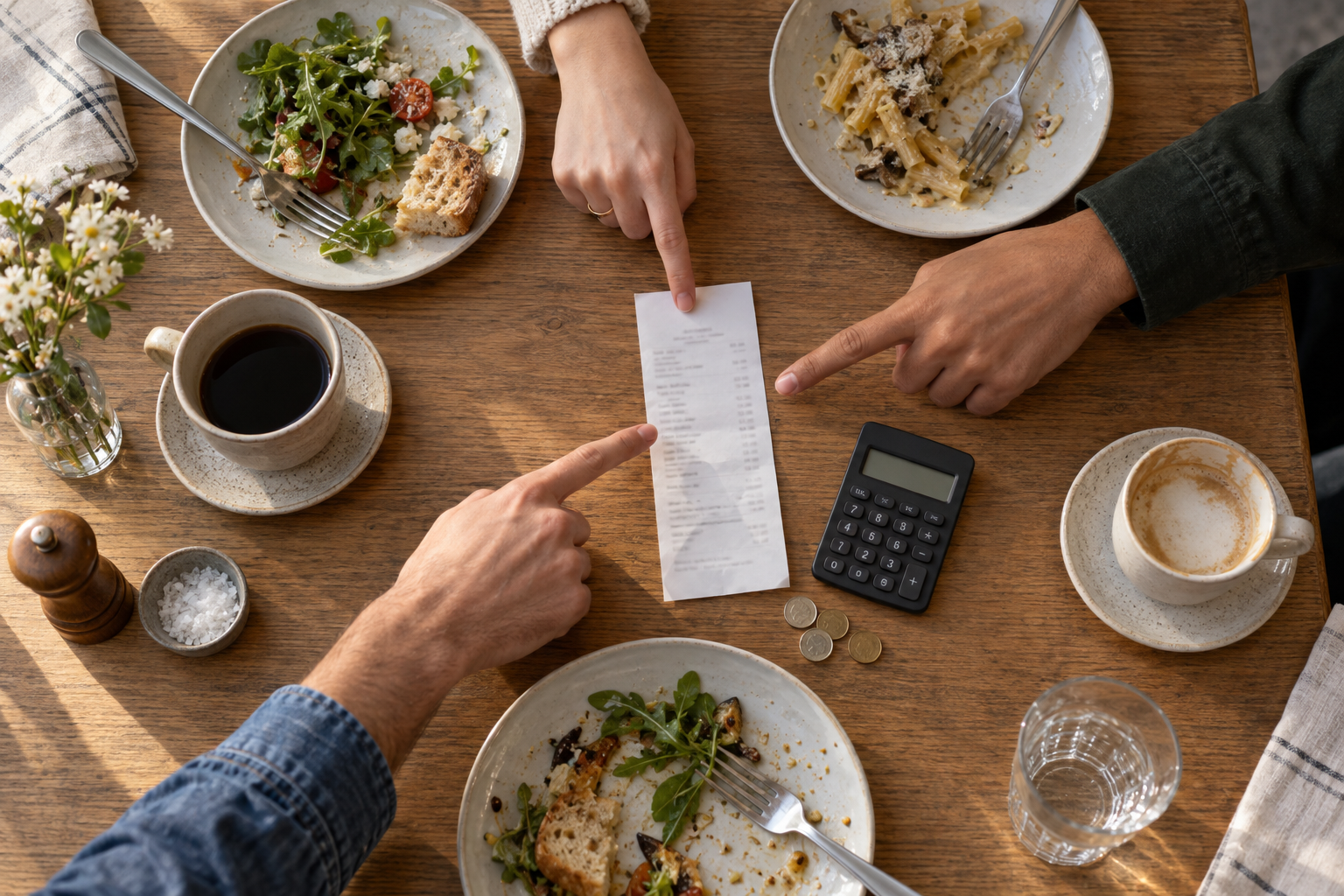
A shared meal is easy to enjoy until one person pays the whole restaurant bill and everyone remembers a different amount. Splitting equally is quick, but it may not fit when someone ordered only a snack, skipped drinks, or shared one dish with just one other person. A fair split does not require a complicated app. It requires agreement on what is shared, one clear total, and a way to settle up.
Choose the rule before the bill arrives
For a small, similar order, an equal split may be fine if everyone agrees. When orders differ noticeably, separate individual items from shared ones. Do not assume the person who suggests an equal split is trying to be unfair—or that the quieter person is comfortable with it. Ask simply: “Shall we split evenly, or pay for what we ordered and share the common items?”
If the restaurant can provide separate checks, ask early rather than at the end of a busy meal. Check whether a shared dish, group offer, deposit, or other charge can actually be divided at checkout. If not, agree who will pay first and when the others will transfer their shares.
Separate personal orders from shared items
Start with the itemized receipt, not a round-number guess. Mark each person’s food and drinks. Then identify the items everyone shared, items shared by only some diners, and any discount attached to a particular purchase. A shared appetizer for three can be divided three ways; a dessert eaten by two need not be charged to the third person.
For example, three diners order individual items costing 18, 24, and 30 units. They also share a 12-unit side equally. The food subtotal is 84. Each person’s share of the side is 4, so their food shares are 22, 28, and 34. Those numbers add back to 84. Using whatever currency the receipt uses, checking that sum is a simple way to catch a missing item or an accidental double charge.
For a more complicated group, keep a short list of who shared each item. You do not need to reconstruct every bite. The aim is an agreed, reasonable method that everyone can verify.
Agree how to divide taxes, service charges, and tips
The food subtotal may not be the final amount paid. Read the actual receipt for taxes, service charges, delivery or booking fees if applicable, and any tip the group chooses to add. These vary by place and transaction, so use the printed amounts rather than assuming a standard rate. Check whether a service charge is already included before adding a separate tip.
Two simple methods are to divide extras equally among the diners or in proportion to each person’s food share. Neither is automatically right for every group; agree on one. Continuing the example, suppose the actual extras total 12 units and the three diners agree to divide them equally. Their final shares are 26, 32, and 38, adding to the 96-unit amount paid. If the group prefers proportional extras, recalculate from the same 84-unit food subtotal and check that the final shares still add to 96. Round in a way that preserves the receipt total, assigning a small rounding difference to one agreed share rather than silently losing it.
Make the first payment and transfers explicit
When one person pays the entire 96-unit bill, that person temporarily fronts the other two shares. In the example, the diners owing 32 and 38 transfer those amounts to the payer, whose own meal cost is 26. Confirm the payment method and timing before leaving. A short message—“Total paid 96; your shares are 32 and 38; please transfer by tomorrow”—is clearer than hoping everyone will remember.
The payer should check that transfers actually arrive. The other diners should not mark a transfer as done until it is sent, and nobody should pay twice because the group used both a payment link and cash. For a larger bill, fronting the whole amount may strain the payer’s balance even if everyone promises to reimburse promptly. If that is a risk, request separate checks or collect transfers before one person pays, if the group and venue can accommodate it.
Record your real cost without counting the meal twice
A payment record can be misleading: the payer’s account shows 96 leaving, while the other diners’ accounts show transfers that may look like generic payments. In your budget, aim to show your own final meal cost. The payer can keep the receipt and incoming transfers together, then reconcile the net 26. The two other diners record 32 and 38 as their meal spending, not as a second expense on top of a separate restaurant charge. If a transfer is still pending, keep the amount owed visible until it clears; a promise is not cash available for another bill.
Furt Money can help you categorize restaurant spending and review the pattern over time. If a full group payment and repayments appear in your expense history, check how they are categorized so you do not mistake the entire group bill for your personal dining cost. A reimbursement tracker can help when money owed back remains outstanding.
Keep the social side easy
Fairness includes the freedom to choose a less expensive order without making a public case for your budget. If you are organizing the meal, share the restaurant’s menu or likely price range beforehand and avoid making one person the automatic payer. If the group often eats together, agree on a default approach, but let anyone request an itemized split without debate.
If a planned dinner does not fit this month’s friendship budget, suggest a simpler place, a coffee, or a different date before anyone orders. At the table, focus on the receipt and a neutral method—not on judging someone’s choices. Clear arithmetic and a kind tone can coexist.
One next step: at your next group meal, agree on equal or itemized splitting before ordering. When the receipt arrives, check that individual shares plus shared items and extras add up to the amount actually paid, then settle transfers while the numbers are fresh.