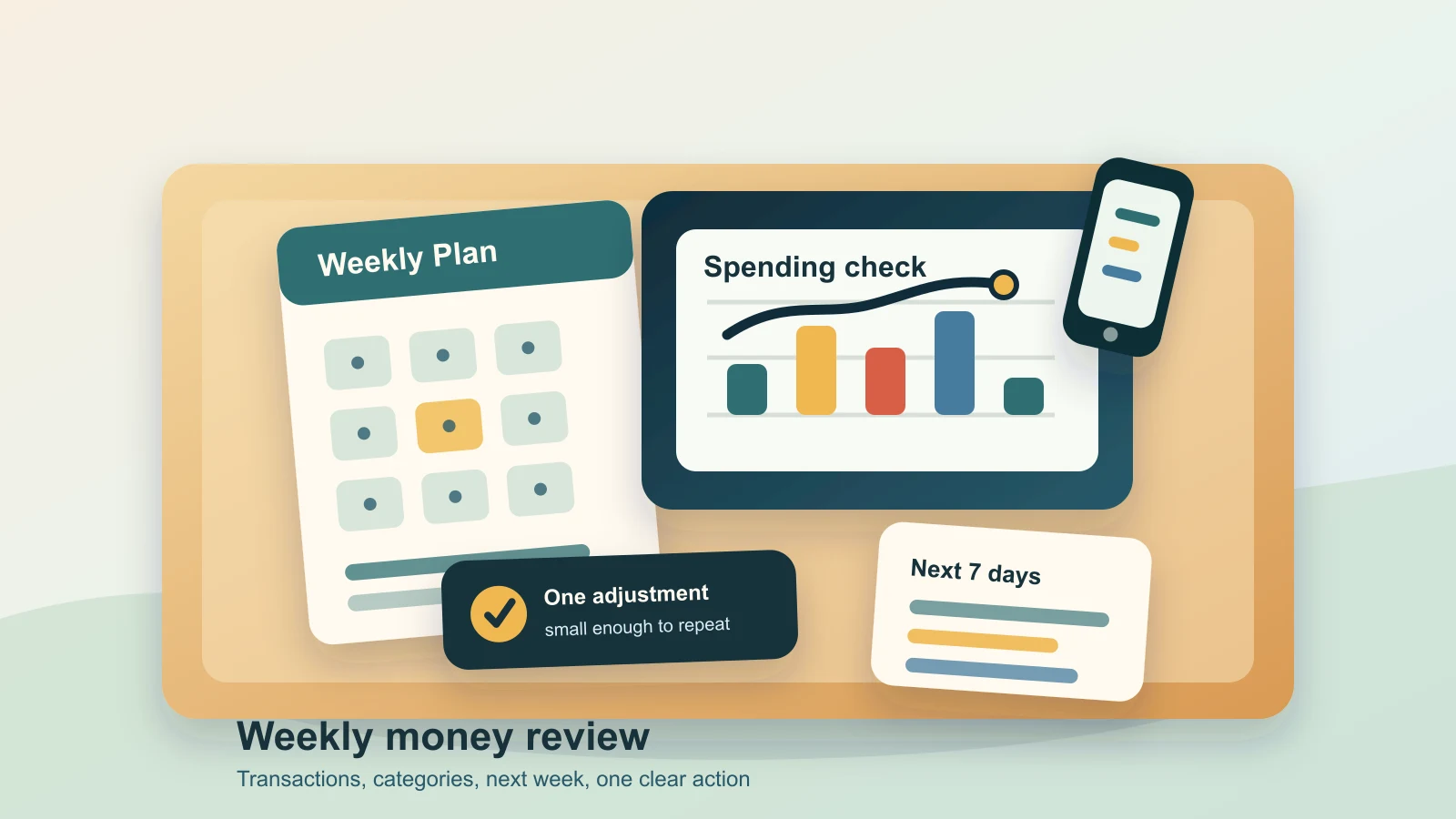
A budget is most useful when you return to it before the month is over. Waiting until the last day often turns money management into a post-mortem: you can see what happened, but you cannot change much. A weekly money review gives you a smaller, calmer checkpoint.
The point is not to inspect every purchase with guilt. The point is to notice patterns while there is still time to adjust. Twenty minutes once a week can help you catch forgotten subscriptions, plan for upcoming bills, slow down a category that is running hot, and decide what your money needs to do next.
Why a weekly review works better than a monthly panic
Monthly budgeting is still useful, but a month is a long time to operate on autopilot. Groceries can climb slowly. Weekend spending can pile up. A bill can clear earlier than expected. By the time you notice, the fix may require an uncomfortable cut somewhere else.
A weekly review shortens the feedback loop. Instead of asking, “Where did all the money go?” you ask, “What changed this week, and what needs attention next week?”
That small shift matters. It turns budgeting into a habit of steering, not scolding. You are checking the road while you can still turn the wheel.
Pick one repeatable time
Choose a time when you can think clearly and access your recent transactions. For many people, that is Friday afternoon, Sunday evening, or the morning after payday. The exact day matters less than making it repeatable.
Try attaching the review to something you already do:
- After you plan groceries for the week
- Before you set up the next workweek
- On the evening after payday
- While you drink your first coffee on Saturday
- Before a weekly household check-in
Keep the appointment short. If the review regularly takes an hour, you may avoid it. A useful weekly review should feel light enough to repeat even when life is busy.
Step 1: Check your account balances
Start with a simple snapshot. Look at your checking account, savings account, credit-card balance, and any wallet or payment app you use regularly. You are not solving everything yet. You are just getting oriented.
Ask:
- How much money is available for the rest of this pay cycle?
- Are there any pending transactions that have not cleared yet?
- Did any payment, transfer, or deposit look different from what I expected?
- Is my credit-card balance growing faster than planned?
This step prevents small surprises from becoming large ones. It also helps you avoid spending the same money twice, especially when transactions are still pending.
Step 2: Categorize recent spending
Next, review the transactions from the last seven days. Categorize anything that is missing, unclear, or sitting in the wrong place. A budget is only as helpful as the labels behind it.
If you use Furt Money to track expenses, this is the moment to clean up categories and look for unusual spikes. A restaurant charge may belong under dining out, not groceries. A pharmacy purchase may belong under health, not shopping. A one-off work tool may need its own note so it does not distort your normal spending picture.
Do not overcomplicate the category list. The goal is clarity, not perfection. If two categories always confuse you, merge them or rename them in a way that matches how you naturally think.
Step 3: Compare actual spending with your plan
Once recent spending is categorized, compare it with the plan you made for the month or pay cycle. Focus on categories that are easy to change during the next few days.
Good categories to review weekly include:
- Groceries
- Dining out
- Transport
- Shopping
- Entertainment
- Personal care
- Small household purchases
Fixed bills matter, but they are usually less flexible once the month has started. Variable categories are where a weekly review can make the biggest difference.
If one category is high, avoid jumping straight to shame. Ask what caused it. Maybe groceries were high because you restocked pantry basics. Maybe transport was high because of a temporary commute change. Maybe shopping was high because several small purchases were not actually planned.
The explanation determines the next step. Some overspending is information. Some is a signal to slow down.
Step 4: Look seven days ahead
A budget can fail because of what already happened, but it can also fail because of what is about to happen. Before you finish the review, scan the next week.
Look for:
- Rent, loan payments, insurance, or utility bills
- Birthdays, school costs, medical appointments, or family events
- Travel, fuel, parking, ride-hailing, or public transport needs
- Subscription renewals
- Social plans that may involve food, gifts, or tickets
- Household items that are running low
Then decide whether your current budget still fits. If the next week is unusually expensive, you may need to pause optional spending for a few days. If the next week is light, you may be able to move extra money toward savings, debt payoff, or an irregular expense fund.
Step 5: Choose one adjustment
Do not end the review with ten promises. Pick one adjustment that is specific enough to act on.
Examples:
- Move a set amount to savings before the weekend.
- Cap dining out at one planned meal this week.
- Use food already at home before another grocery run.
- Delay a non-urgent purchase for seven days.
- Set aside money for an annual bill that is coming soon.
- Pay down part of the credit-card balance before making new purchases.
One clear adjustment is better than a dramatic plan you will forget by Tuesday. The review should create momentum, not a new source of pressure.
Step 6: Leave a short note for next week
End with a quick note to your future self. Write down what changed, what needs watching, and what you decided. Keep it plain.
For example:
“Groceries were high because we restocked staples. Dining out needs to stay low until payday. Car service is due next month, so move a small amount to that fund.”
This note makes next week’s review easier. You will not have to reconstruct the story from memory. Over time, these notes also reveal patterns: the weeks when spending rises, the categories that need more realistic limits, and the habits that help you recover quickly.
A simple 20-minute checklist
Use this flow when you do not want to think too hard:
- Check account and card balances.
- Review the last seven days of transactions.
- Fix missing or incorrect categories.
- Compare variable spending with your budget.
- Scan the next seven days for bills and plans.
- Choose one adjustment.
- Leave a short note for next week.
If you finish early, stop. A review that takes twelve focused minutes is still a win.
Make the review easier to repeat
The best weekly money review is boring in a good way. It should use the same steps each time, in the same order, with the same few questions.
Keep your tools simple. You might use Furt Money for expense categories and spending patterns, plus a calendar for upcoming bills. You might keep a notes app open for the weekly summary. You do not need a complicated spreadsheet unless you genuinely enjoy maintaining one.
It also helps to make the review non-negotiable but flexible. If Sunday evening does not work this week, do it Monday morning. Missing the exact time is not a failure. Skipping the habit entirely is what makes the budget go stale.
The bottom line
A weekly money review keeps your budget close to real life. It helps you notice what changed, plan what is coming, and make one useful adjustment before small issues become bigger ones.
Try it once this week. Set a 20-minute timer, review the last seven days, look at the next seven days, and choose one action. That is enough to make your budget feel less like paperwork and more like a tool you can actually use.