The price tag is only one part of owning an appliance. A fan you use every day and a heater you switch on occasionally can have very different effects on your electricity bill. Appliance running costs give you a way to compare those effects before you buy something, change a habit, or assume one device caused a higher bill.
You do not need a perfect forecast. You need the appliance’s likely electricity use, a realistic amount of time in use, and the price your provider charges for that use. Keep the estimate separate from the rest of the household bill.
Start with the right number: watts or kilowatt-hours
A device’s power rating is often printed in watts (W) on its label or in its manual. Power describes how quickly it uses electricity while operating at that level; it does not tell you how long it will run. Divide watts by 1,000 to express power in kilowatts (kW). Multiply kilowatts by hours of use to estimate energy in kilowatt-hours (kWh), the unit commonly used for electricity consumption.
Estimated kWh = watts ÷ 1,000 × hours used. If you use the appliance on several days, multiply by those days too. The arithmetic is simple, but the input matters: a label may show maximum power rather than average use. A fridge cycles on and off, a variable-speed fan changes settings, and some devices draw power while idle. Where available, an energy label’s stated consumption or a measured reading may be more useful than multiplying the maximum wattage by every hour plugged in.
Work through one ordinary-use example
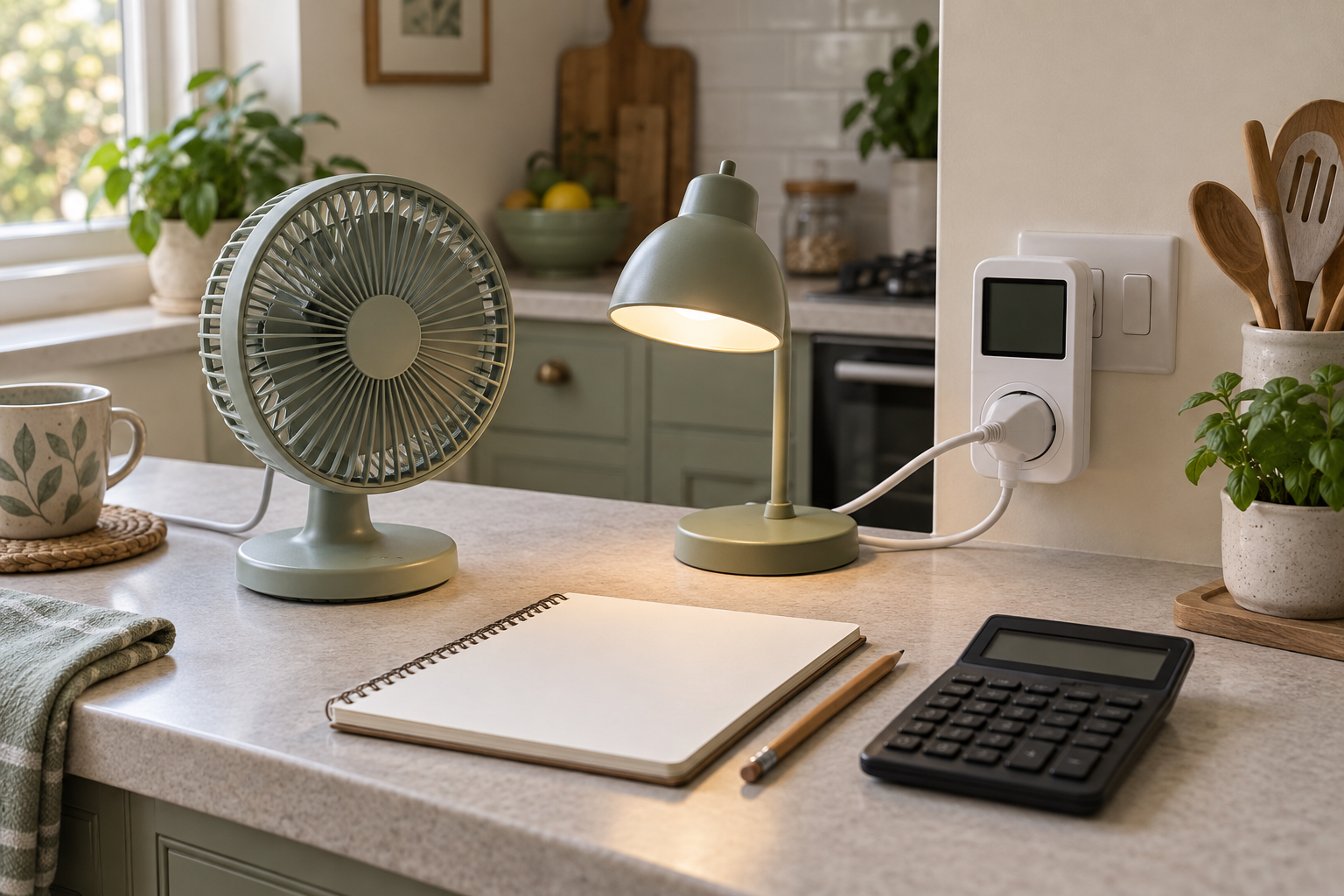
Suppose a 60 W fan runs about five hours a day for 30 days. At a steady 60 W, the estimate is 60 ÷ 1,000 × 5 × 30 = 9 kWh. If the electricity portion of your tariff were a purely illustrative 0.20 currency units per kWh, that portion would be 1.80 currency units for the month. Neither number is a quoted price or a prediction of your bill; actual wattage, usage, and tariffs vary.
Write down your own three inputs before estimating: the power or measured consumption, the hours you actually expect to use it, and your current charge per kWh. If usage varies, calculate a low-use and a high-use case instead of treating one number as precise. A five-hour estimate is not useful if you normally leave the fan running for ten.
Use your bill to find a sensible price assumption
Look for the energy or usage charge and its unit on a recent bill. Providers may use more than one price tier, time-of-use period, fuel adjustment, tax, or other charge. A promotional or bundled figure might not be the marginal price of extra electricity. Read your provider’s current tariff or bill explanation if you are unsure which rate applies.
For a rough decision, show the energy-only estimate first, then note any additional usage-linked charges that could change it. Do not multiply a fixed monthly connection fee by the appliance’s kWh: that fee may be due whether the appliance runs or not. Likewise, dividing the entire bill by its kWh can mix fixed fees and other services into an apparent unit price. In a tiered plan, extra use may fall into a different tier; in a time-of-use plan, when you run the device matters. Mark the result as a range when the price is uncertain.
Compare two devices on the same job
If you are choosing between appliances, compare the same task and usage pattern. One machine may draw more power but complete a cycle faster. For a refrigerator or washer, a standardized energy-label estimate or a measured cycle can be more meaningful than the wattage printed near the plug. Check the label’s assumptions: capacity, cycle choice, and usage frequency may differ from yours.
A quick comparison note can include:
- Purchase price, delivery, installation, and any needed accessories
- Estimated kWh for the same week or year of realistic use
- Your current usage-linked electricity price, with any uncertainty noted
- Maintenance or consumables you would still pay for
- The difference in total cost over the period you expect to keep it
For example, if one option costs 80 more upfront and your estimated electricity saving is 10 per year, simple arithmetic suggests eight years to offset that difference through electricity alone. It is not a guarantee: the device may not last eight years, your usage or tariff may change, and repairs or comfort may matter more. Avoid paying an unlimited premium just because a label says “efficient.”
Measure when the label is not enough
For a suitable plug-in device, a compatible power meter may show kWh over a normal period of use. Follow the meter’s and appliance’s safety ratings; do not use a plug-in meter with hardwired equipment or a load outside its rated capacity. Record both the reading and the hours or cycles it covers. A one-day test may miss a weekend, seasonal change, or different setting.
Where a meter is not suitable, compare your bills’ kWh across similar periods rather than blaming one appliance from a single higher total. Weather, household occupancy, billing-cycle length, other devices, and tariff changes can all move the bill. If a large unexplained jump persists, inspect the bill and contact the provider or an appropriate professional rather than experimenting with unsafe electrical work.
Put the estimate into your budget without double-counting
The actual electricity bill belongs in your utilities category. The appliance estimate is a planning note, not an extra charge to add on top of that same bill. If you are considering a new device, estimate the incremental monthly usage and leave room in your utility budget for it; after a few bills, check whether the household total changed as expected.
If you use Furt Money to track expenses, categorize the actual appliance purchase separately from your recurring utility payment and review the utility category over time. The app can help you see spending patterns, but it cannot tell you how many kWh an individual appliance used from an expense entry alone. Keep wattage assumptions or meter readings in your own note and revisit them if your routine changes.
Make the decision that fits the whole household
Running cost is one input, not the entire choice. Comfort, accessibility, safety, repairability, noise, space, and whether the device will actually be used all count. Replacing a functioning appliance solely to chase a small estimated electricity saving can create a larger upfront cost than the saving justifies. On the other hand, frequent use can make an efficiency difference worth comparing carefully.
Next time you consider an appliance, write down its purchase price, a realistic weekly use pattern, and one low-to-high electricity estimate using your own current tariff. That short calculation is enough to replace a vague “it must be expensive to run” with a decision you can revisit after the first bill.