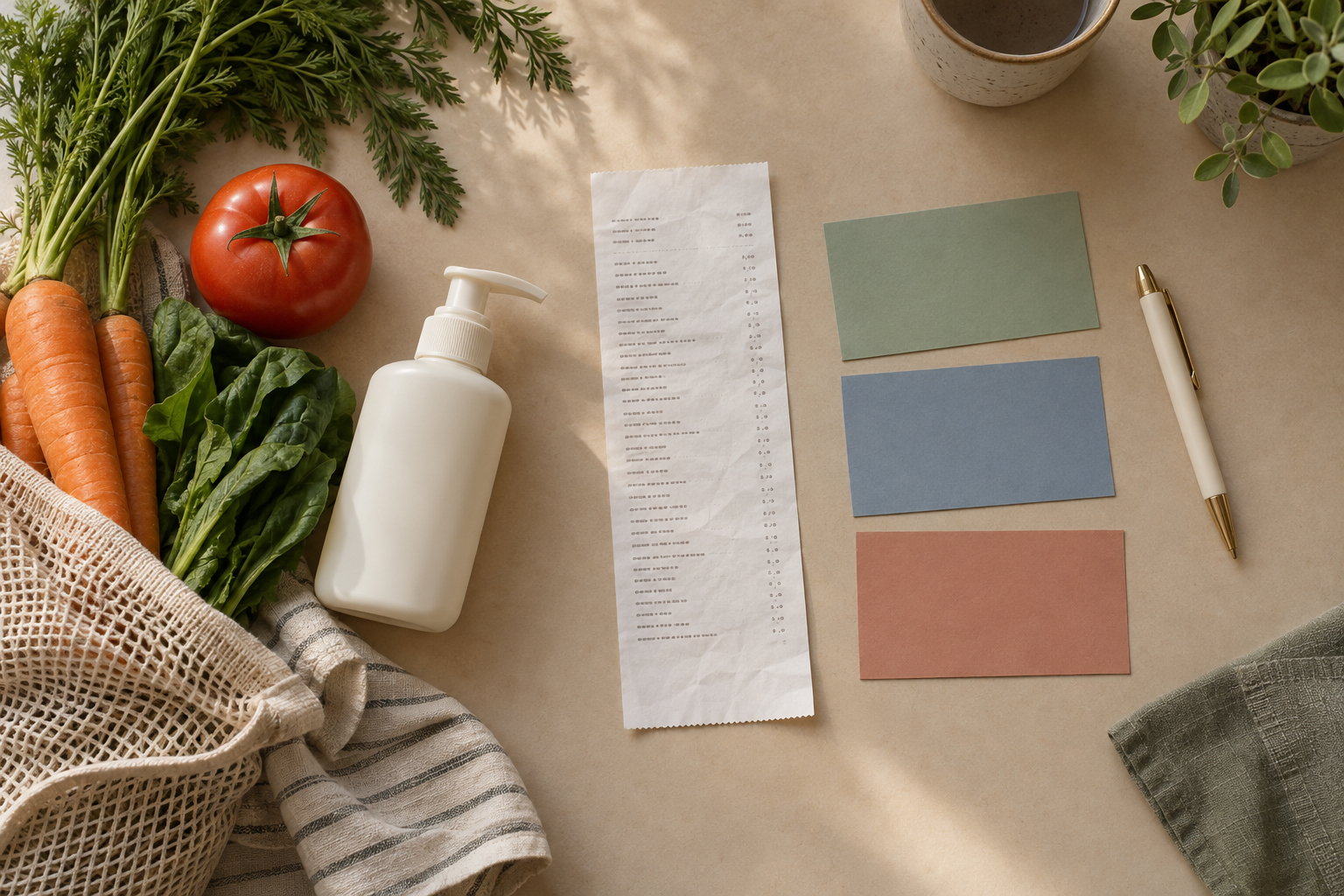
You stop at one store for dinner ingredients, laundry detergent, and a birthday card. Your bank statement shows one charge. Your budget has three different places those purchases could go. If you put the entire charge under groceries, the grocery total looks high and the other costs disappear.
You do not need to divide every small purchase. But learning how to split a receipt across budget categories makes a mixed, meaningful purchase easier to understand without counting the same money twice.
Decide whether the split is worth doing
A useful budget is not a perfect ledger of every item. Start with the decision the categories help you make. If a small household item is tucked into an otherwise ordinary grocery run, one category and a note may be enough. If a large gift or pharmacy purchase would change how you judge your grocery spending, separate it.
Try a consistent rule: split a receipt when a non-primary category is large enough to change a spending decision this month. Otherwise, assign the full amount to the main purpose and note the exception if you want to remember it. This keeps tracking manageable while making important differences visible.
The store name is not the category. A supermarket receipt can contain groceries, household supplies, medicine, and gifts. Categorize by what you bought, not just where you paid.
Work from the final receipt and the actual charge
Use the final receipt rather than a cart estimate or pending card authorization. Check whether an item was removed, a discount was applied, or a tip or delivery charge was added. Then compare the receipt total with the posted charge. A temporary hold may not be the final payment.
Write down the charge once as your control total. For example, suppose the posted charge is 84 units of your currency. The receipt shows 52 for groceries, 21 for household supplies, and 11 for a pharmacy item, with any tax and discounts already reflected in those amounts. Your category entries are 52, 21, and 11. Their sum is 84, not 168: the single bank charge is the source of those parts, not a fourth expense.
If you keep a manual ledger, use one transaction with category lines or a clear note linking the separate entries to the same receipt. Do not record both the full charge as spending and the split amounts as additional spending.
Give discounts, tax, and delivery a repeatable home
Mixed receipts rarely divide as neatly as the example. A storewide discount, sales tax, service fee, or delivery charge may sit below the item list. Choose a method you can repeat rather than chasing tiny precision that will not affect a decision.
For item-specific discounts, subtract the discount from the item’s category. For a discount across the whole basket, you can distribute it roughly in proportion to the category amounts. A simpler option is to put the shared adjustment with the largest category when it is small. Assign an item-specific tax or fee with that item; for a shared fee, use the same proportional or main-category rule. Check the receipt for the actual amounts rather than assuming every item is treated alike.
Finally, add the category totals. If rounding leaves a small difference, adjust one category so the sum exactly matches the posted charge. Your goal is a useful breakdown that reconciles, not a second invented total.
Keep reimbursements separate from category splits
Splitting a purchase by purpose is different from splitting it among people. If you pay for your own groceries and a friend’s item, the full charge still leaves your account now. Record your own spending in the appropriate category and track the amount owed back separately. Do not treat a promised repayment as money already available for bills.
When the repayment actually arrives, match it to the amount owed. Avoid counting it as both new income and a reduction to a spending category. If you often front shared purchases, keep a short pending-repayment list with the person, amount, purchase, and follow-up date. The purpose here is to keep your personal category totals and your current cash position honest at the same time.
Handle returns without losing the original story
A return or partial refund may arrive days later, sometimes in another budget period. Keep the original receipt or a brief note until the refund posts. Then link the returned amount to the category that held the original item. If a household item worth 21 from the example is returned, reduce or offset household spending by 21 when the refund clears; do not erase the grocery and pharmacy portions.
If the seller offers store credit rather than money back to your account, note that separately. It is not cleared cash for your next bill. If the refund is partial, record only the amount actually received. This also gives you a way to reconcile a receipt whose final cost changed after purchase.
Use a short routine for recurring mixed purchases
Make the process quick enough to repeat:
- Wait for the final receipt and posted charge.
- Highlight only the categories that matter to your decisions.
- Apply discounts and shared charges with one consistent rule.
- Check that category parts add up to the posted charge.
- Note any pending repayment, return, or refund separately.
If you track expenses in Furt Money, review the categories where mixed purchases tend to land and look for patterns at your next budget review. You can keep the receipt breakdown in your own notes if that is the clearest way to preserve it. The important part is that your spending review reflects the real purposes of the purchase, without assuming a particular app feature is needed.
Let the numbers answer one question
Splitting a receipt is useful only when it helps you see something you would otherwise miss. Perhaps household supplies are not actually part of your food budget. Perhaps a one-off gift made this week’s grocery trip look unusually expensive. Once the categories are honest, ask whether any plan needs changing—or whether the month simply had an unusual purchase.
Start with the next mixed receipt that would noticeably distort a category. Split that one, reconcile it to the posted charge, and leave the tiny ones alone unless they begin to form a pattern.