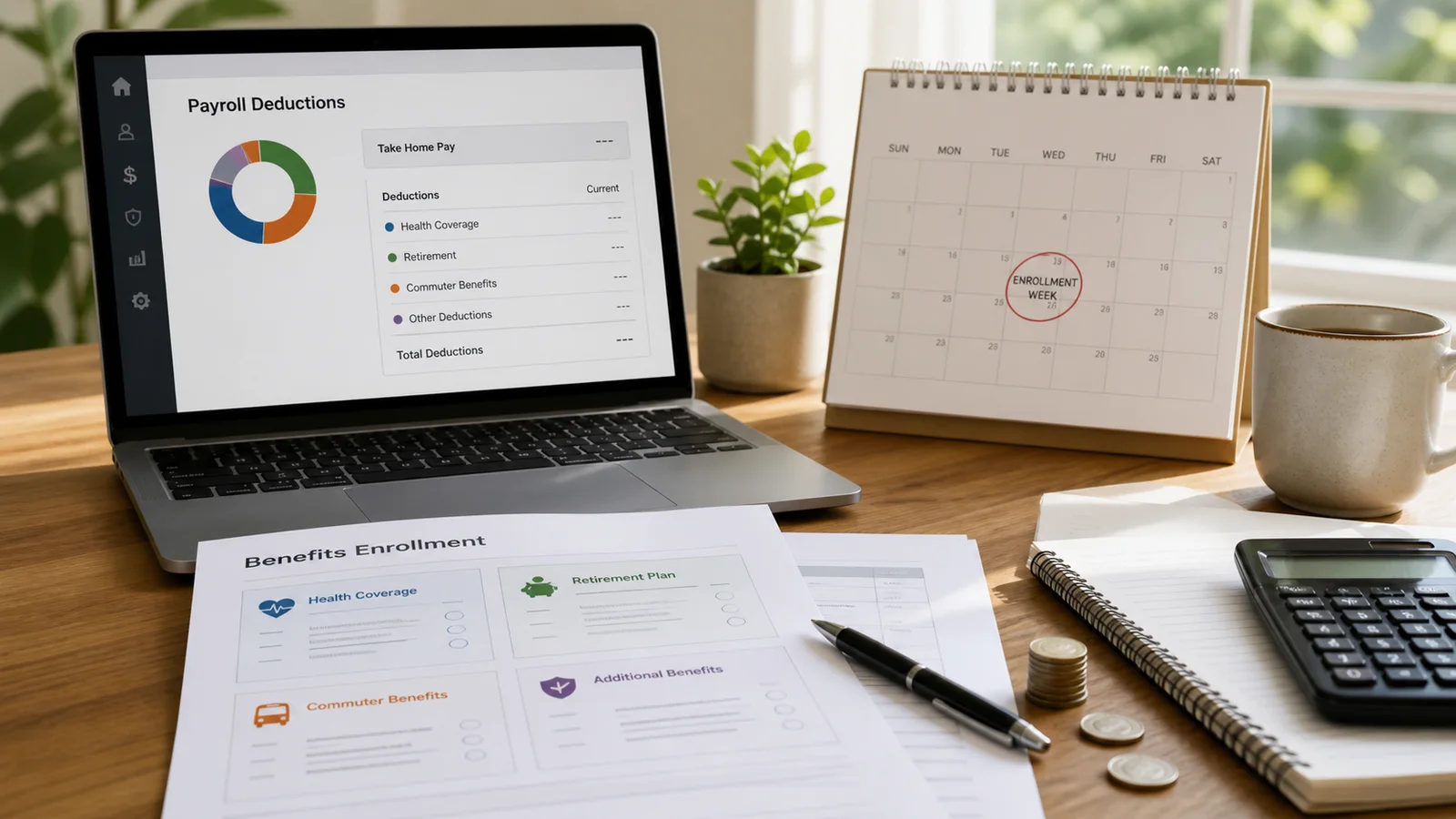
Benefits enrollment can feel like paperwork, but it is really a budget decision. A health plan, retirement contribution, insurance add-on, commuter benefit, or savings account election can change how much money reaches your checking account every payday.
That does not mean every deduction is bad. Some benefits protect you, support long-term goals, or lower the friction of everyday life. The problem is choosing them in a hurry and then wondering why take-home pay feels different.
An employee benefits budget gives you a simple way to connect enrollment choices to your real monthly cash flow before the first changed paycheck arrives.
Start with your current take-home pay
Before comparing options, write down what you currently receive after taxes and deductions. Use actual deposits, not your salary or hourly rate. Your budget runs on the money that lands in your account.
Look at the last few normal paychecks and note:
- Gross pay before deductions
- Taxes and required withholdings
- Health, dental, vision, or other insurance deductions
- Retirement contributions
- Flexible spending, health savings, commuter, or childcare deductions
- Any voluntary insurance or workplace giving
- Net pay after everything is taken out
If one paycheck included overtime, a bonus, unpaid time, or a reimbursement, label it as unusual. You want your employee benefits budget to start from a normal pay pattern so one odd check does not distort the plan.
Separate protection, savings, and convenience
Benefits are easier to compare when you group them by the job they do. Otherwise, everything can blur into one long enrollment screen.
Use three plain groups:
- Protection: health coverage, disability coverage, life insurance, and other benefits meant to reduce financial shock.
- Savings: retirement contributions, savings accounts, and payroll deductions that move money toward a future need.
- Convenience: commuter benefits, wellness programs, employee purchase plans, or services that make work and life easier.
This does not decide what you should choose. It simply makes the tradeoffs clearer. A protection benefit may cost more each paycheck but reduce risk. A savings deduction may lower spending money now while supporting a future goal. A convenience benefit may be useful only if you actually use it.
When a benefit does not fit any group or you cannot explain why it helps, pause before accepting it.
Estimate the paycheck change before you enroll
The most useful number is not only the monthly premium or contribution. It is the change in take-home pay per paycheck.
For each benefit you are considering, write the expected deduction next to your pay schedule. A monthly deduction feels different when you are paid weekly, twice a month, or every two weeks. If your employer shows a paycheck preview, use it. If not, make a rough estimate and leave room for small differences.
Ask:
- How much less will reach checking each payday?
- Which current budget category will absorb that change?
- Does the deduction happen every check or only some checks?
- Will it start immediately, after a waiting period, or at the next plan year?
- Is the election easy to change later, or mostly locked until the next enrollment window?
Do not rely on memory after enrollment. Save the estimate so you can compare it with the first real paycheck.
Look beyond the premium
For insurance-related benefits, the paycheck deduction is only one part of the cost. A plan with a lower premium can still be expensive if routine care, prescriptions, deductibles, co-pays, or out-of-network rules create costs you are not ready for. A higher premium can still strain the budget if it leaves too little cash for rent, food, debt payments, or emergency savings.
Keep the review practical. Instead of trying to predict every possible medical or insurance outcome, look at the expenses you can reasonably expect:
- Regular appointments, prescriptions, or therapies
- Dependents who use the plan
- Preferred doctors, clinics, pharmacies, or networks
- Deductibles, co-pays, coinsurance, or similar out-of-pocket wording
- Claims or reimbursements that may require upfront payment
- Timing of premiums and likely non-premium costs
If a term is unclear, use the plan documents or ask the benefits team. Do not guess on a choice that can affect both your paycheck and your emergency fund.
Give retirement contributions a budget check
Retirement contributions are often framed as a long-term decision, but they also affect this month’s cash flow. A contribution that looks responsible on paper can become stressful if it leaves every pay cycle too tight.
Start with what is repeatable. Check whether your essentials, near-term bills, starter emergency fund, debt plan, and irregular expenses still work after the contribution. If they do, the deduction may fit cleanly. If they do not, you may need to adjust the amount, reduce another category, or build a little more breathing room first.
Also check how employer matching rules, vesting, account access, and contribution changes work in your workplace. Those details vary, so avoid treating a generic rule of thumb as a personal instruction.
If you use Furt Money to review categories, compare recent flexible spending with the contribution you are considering. The goal is not to squeeze your budget until it hurts. It is to choose an amount that can survive normal weeks.
Watch the small voluntary benefits
Enrollment screens often include add-ons that sound inexpensive: extra insurance, legal services, identity tools, purchase programs, wellness upgrades, or charitable giving. One small deduction may be fine. Several small deductions can quietly reduce take-home pay.
Review each optional benefit with the same questions:
- What problem does this solve for me?
- Do I already have similar coverage or access somewhere else?
- How often did I use it last year?
- Is the cost per paycheck clear?
- What happens if I do not choose it?
- Can I cancel later, or is it tied to the enrollment year?
Do not choose an add-on only because it is offered at work. A benefit earns its place when it solves a real need at a cost your budget can carry.
Build a first-paycheck review
After enrollment, the first changed paycheck deserves a quick review. This is where your estimate meets reality.
When the paycheck arrives, compare:
- Expected net pay versus actual net pay
- Each deduction name and amount
- Any benefit that did not start yet
- Any deduction you did not expect
- Whether the new take-home amount still covers your planned categories
If something looks wrong, contact payroll or benefits quickly. Some issues are simple timing differences. Others may need correction before they repeat.
Then update your budget categories. If take-home pay dropped by a predictable amount, do not leave the old spending plan untouched. Decide which category changes now so the adjustment does not show up later as credit-card debt, late bills, or a shrinking cash buffer.
Keep one benefits note for next time
Benefits choices are easier the second time if you keep a short record. After enrollment, save one note with the choices you made and why.
Include:
- Plan names or benefit names
- Per-paycheck deduction estimates
- Important coverage or access notes
- Renewal or enrollment dates
- Questions to revisit next year
- Benefits you skipped and the reason
- Changes to check on the first paycheck
Keep sensitive documents somewhere secure and avoid storing passwords or private identity details in an ordinary note. The goal is a simple decision record, not a second payroll system.
Next enrollment season, this note gives you a starting point. You can compare what changed, what you actually used, and which deductions still deserve space in your paycheck.
The bottom line
An employee benefits budget turns enrollment from a rushed form into a clearer money decision. Start with your current take-home pay, group benefits by purpose, estimate the paycheck change, and review the first real paycheck after enrollment.
Choose one benefit you are unsure about and write down its cost per paycheck, what it does, and which budget category it affects. That small step can make the whole enrollment process feel less like guesswork.