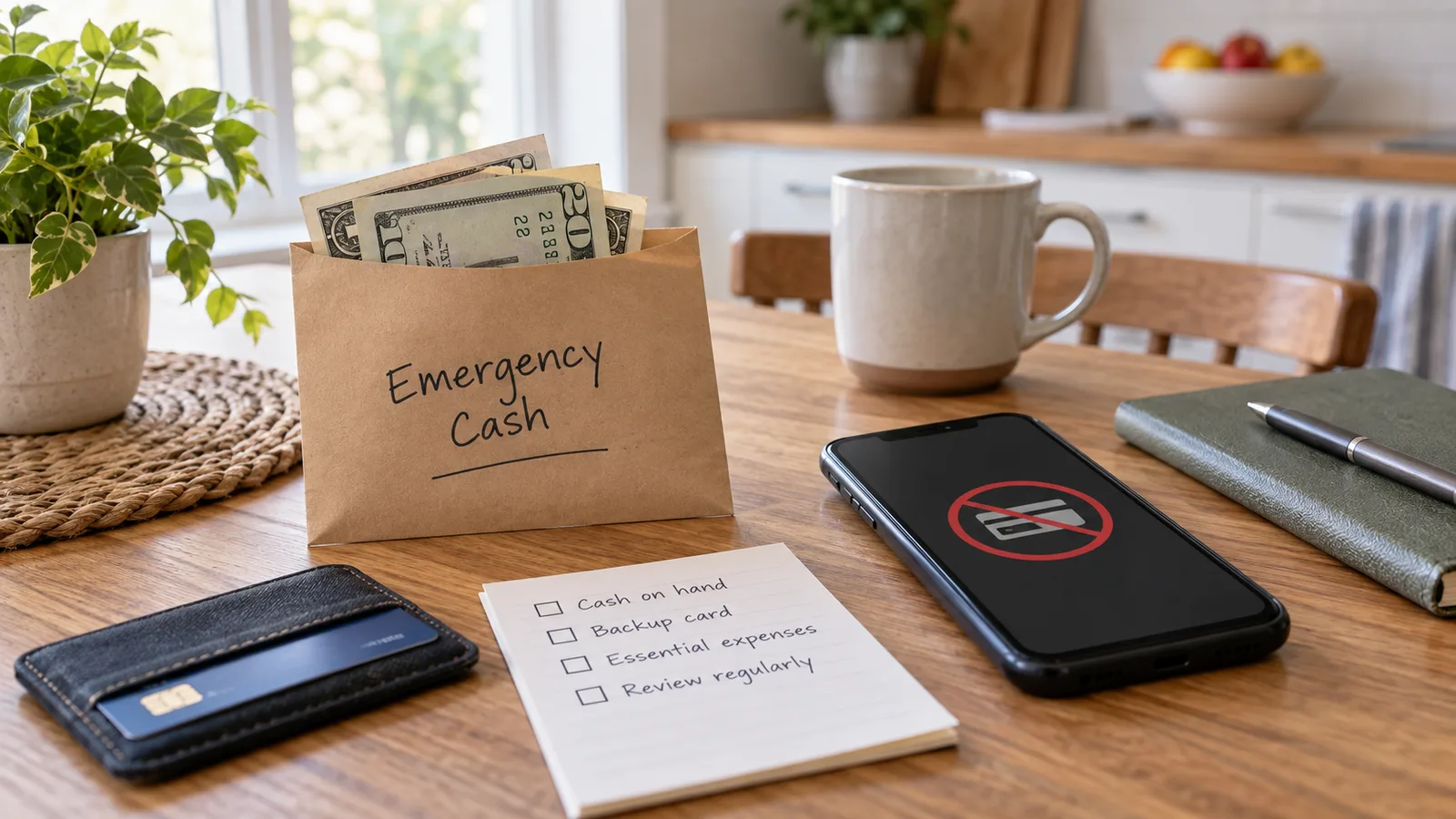
Most money plans assume payments will work when you need them. Cards tap, bank apps load, transfers move, and the nearest ATM is available. Usually that is true. Occasionally, it is not.
An emergency cash plan is a small backup for those awkward moments: a card is lost, your phone battery dies, a payment app is down, a storm interrupts service, a shop is cash-only, or you need transport before you can sort out a bigger problem. It is not a replacement for an emergency fund. It is a practical layer that helps you handle the first few hours without panic.
What an emergency cash plan is
An emergency cash plan is a clear answer to three questions:
- How much physical cash would actually help in a short disruption?
- Where will you keep it so it is available but not mixed with everyday spending?
- When will you review it so the amount still fits your life?
The goal is not to keep a dramatic amount of money at home. The goal is to have enough backup cash to solve basic friction: transport, a simple meal, medicine, a small fee, or a temporary payment problem. For some people that means a modest envelope. For others it means a small split between home, wallet, and travel bag.
Keep it separate from your emergency fund
Your emergency fund is for bigger disruption: income gaps, repairs, medical bills, urgent travel, or essential costs that cannot wait. Emergency cash is narrower. It is for access.
That distinction matters because cash kept too casually can disappear into normal spending. If the envelope becomes coffee money, tip money, or “I will replace it later” money, it stops doing its job.
Give the cash a label and a rule. For example: “Use only when normal payment methods are unavailable or unsafe to rely on.” A simple rule prevents the backup from turning into another vague category.
Choose a realistic starter amount
Do not start by copying someone else’s number. Start with your own short disruption scenario.
Ask what you would need if digital payments failed for one ordinary day:
- local transport or fuel
- one basic grocery run or meal
- a pharmacy purchase
- parking, tolls, or small fees
- a taxi, ride, or ride-share alternative
- a phone charger, transit card top-up, or other practical fix
Then choose a starter amount that would help without making you uncomfortable. If money is tight, begin smaller and build the envelope over a few pay cycles. A partial backup is still better than no backup.
Decide where cash should live
The best place depends on why you might need it. Think in layers.
Home cash can help during local outages, bank issues, or moments when you cannot get to an ATM quickly. Keep it somewhere boring, private, and memorable. Do not hide it so cleverly that you forget it exists.
Wallet cash can help with small payment failures away from home. Keep it modest and separate from money you plan to spend. If you use it, replace it during the next budget review.
Travel cash can help when you are away from your usual banking setup. It should be enough to handle small gaps, not so much that losing the bag becomes its own emergency.
If you share money with a partner or household, decide who knows where the cash is and what it is for. A backup nobody can find is not much of a backup.
Make replacement part of the budget
The easiest emergency cash plan to maintain is one with a refill rule. Without one, the envelope can stay half-empty for months.
Try one of these rules:
- Refill it during your weekly money review if any cash was used.
- Add a small amount every payday until it reaches the target.
- Check it after travel, storms, power cuts, bank issues, or busy cash-heavy weeks.
- Review the target when your transport, work routine, family needs, or neighborhood changes.
If you track spending in Furt Money, set the envelope up as a savings goal (“Save 150 for emergency cash”) and add each withdrawal to it instead of filing it under a category. Money in a goal is set aside rather than counted as spending, which matches what actually happened: the cash left the bank, but it has not been spent. When you do use some of it, take that amount out of the goal and record the actual purchase in the same step, so the spending is visible and the goal shows what needs refilling.
Protect it from two common mistakes
The first mistake is making the plan too large too quickly. If building the cash envelope causes missed bills, credit-card debt, or stress in the rest of the budget, slow down. Emergency cash should support stability, not compete with essentials.
The second mistake is forgetting small denominations. A backup made only of large bills may be less useful when you need a small purchase, tip, fare, or local service. Keep the mix practical for the way you live.
Also think about basic security. Avoid showing the cash, talking about the amount casually, or keeping it in an obvious place. If you live with roommates, visitors, or frequent guests, privacy matters even more.
Use a simple review checklist
Once a month, take two minutes to check:
- Is the cash still there?
- Did anyone use it?
- Does the amount still match real short-term needs?
- Are the denominations useful?
- Is the storage place still sensible?
- Does your budget need a refill line this pay cycle?
This is also a good moment to look at recent spending patterns. If cash keeps getting used for non-emergencies, the issue may not be the cash plan. It may be that your everyday categories need more realistic limits.
When cash is not the full answer
Cash can help with access, but it does not solve every emergency. You may still need a broader emergency fund, backup cards, updated account recovery details, important phone numbers, copies of key documents, or a plan for contacting your bank.
Keep the cash plan small and practical. It should make a bad afternoon easier, not carry the full weight of your financial safety net.
The next step
Pick one short scenario: your card stops working, your phone dies, or the local payment system is unavailable for a day. Write down what you would need to pay for before things are fixed. Then choose one starter amount, put it in a clearly labeled place, and add a refill reminder to your next money review.
That small backup can make the difference between a frustrating inconvenience and a budget problem that follows you into next week.