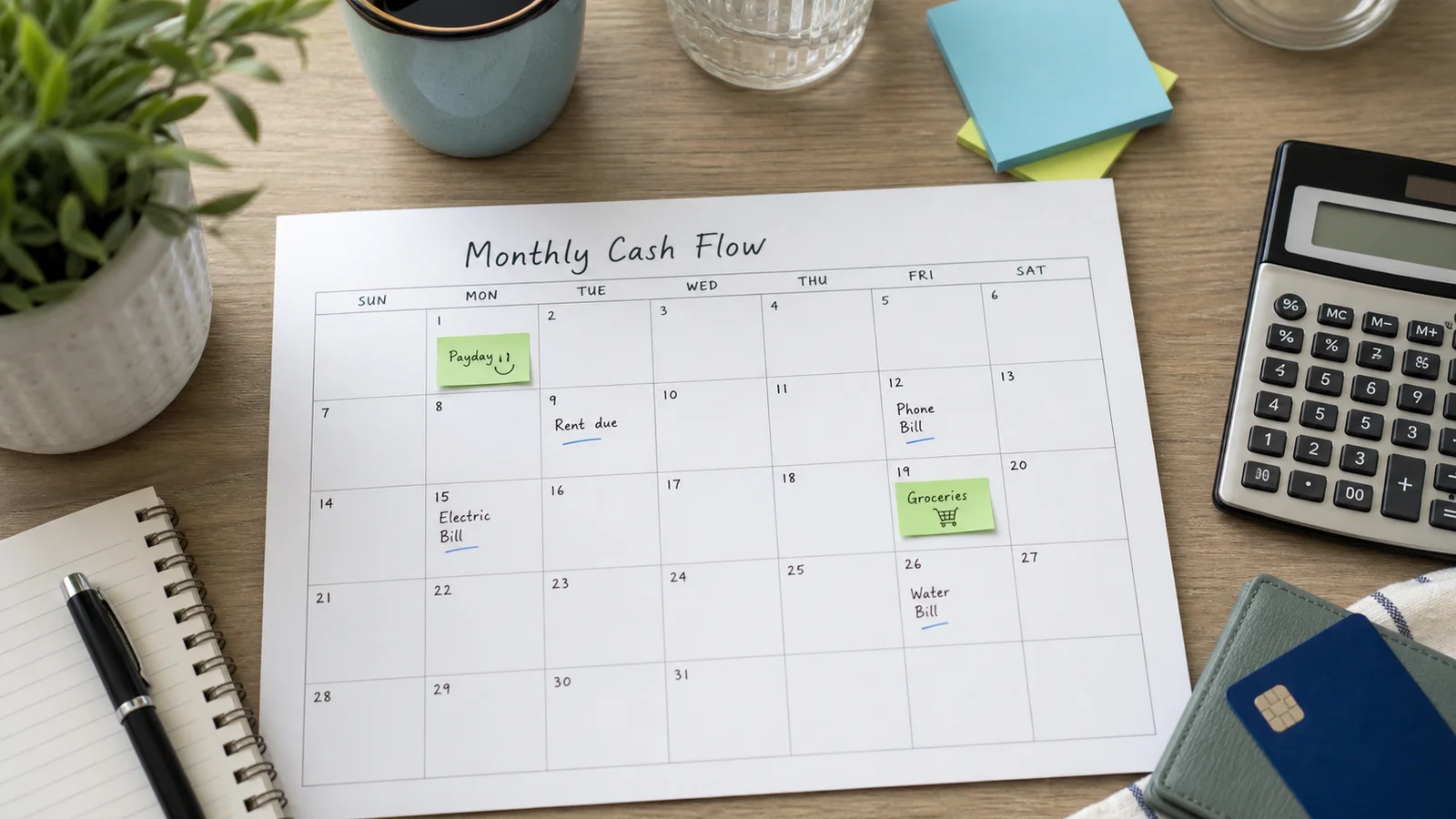
A monthly budget can look balanced and still feel stressful. The reason is usually timing.
Rent may leave before payday. A card payment may land the same week as groceries. An annual fee may arrive in a month that already has travel, school costs, or a repair. On paper, the total income might cover the total spending. In real life, the order matters.
A cash flow calendar shows that order. It gives every payday, bill, transfer, and planned expense a place on the calendar so you can spot tight weeks before they turn into overdraft stress or credit-card reliance.
What a cash flow calendar is
A cash flow calendar is a simple calendar view of money moving in and out.
It does not need to be a complicated spreadsheet. You can use a paper calendar, a notes app, a digital calendar, or a basic monthly planner. The format matters less than the habit of seeing dates clearly.
At minimum, your calendar should show:
- paydays or expected income dates
- rent, mortgage, or housing payments
- utilities, phone, internet, insurance, and loan payments
- credit-card payment dates
- automatic transfers to savings or sinking funds
- known irregular expenses, such as renewals, gifts, travel, medical appointments, or school fees
The goal is not to predict every coffee or snack. The goal is to see whether your major commitments are landing in a reasonable order.
Start with money coming in
Begin by marking every date when money is likely to arrive. Use take-home income, not gross income. If you are paid monthly, this part is easy. If you are paid weekly, every two weeks, by project, or from multiple sources, the calendar becomes even more useful.
For each income date, write a conservative amount. If your income varies, use the amount you can reasonably count on, not the best-case month. Variable income budgets work better when the calendar is built around the dependable baseline.
If a payment date is uncertain, mark it as expected rather than guaranteed. That small distinction helps you avoid spending money before it actually lands.
Add fixed bills before flexible spending
Next, place your fixed bills on their actual due dates. These are the expenses that are usually harder to change once the month starts.
Common fixed or scheduled items include:
- housing
- debt payments
- utilities
- phone and internet
- insurance
- childcare or school fees
- subscriptions and memberships
- planned transfers to savings
Now look at the spacing. Are several bills stacked in the first few days of the month? Does a credit-card payment land right before payday? Are annual renewals hiding in one awkward week?
This is where the calendar starts helping. You may not need to spend less overall. You may need to move a due date, hold more cash in checking before a heavy week, or shift a flexible purchase until after the next income date.
Give each pay period a job
Once income and bills are visible, divide the month into pay periods. Each pay period should answer one practical question: what does this money need to cover before the next payday?
For example, a paycheck might need to cover:
- rent
- two grocery trips
- a phone bill
- transport
- a minimum credit-card payment
- a small transfer to savings
After those commitments are covered, the remaining amount is your real flexible room for that pay period. This is often more useful than looking at the full month’s income at once.
If a pay period looks too tight, do not wait until it arrives. You can plan the fix while there is still time. That might mean delaying a non-essential purchase, using money from a sinking fund for a known irregular expense, or setting aside part of the previous paycheck.
Watch for the three pressure points
Most cash flow problems show up in one of three places.
A bill cluster happens when too many fixed payments land close together. If possible, ask providers whether you can move due dates so bills are spread more evenly.
A low-gap week happens when there are several days between a major bill and the next payday. A checking account buffer can help, but the calendar tells you when the buffer is most likely to be tested.
A forgotten non-monthly cost happens when a renewal, repair, gift, or travel expense appears outside your normal budget rhythm. Add these items as soon as you know about them, even if the amount is only an estimate.
You do not have to solve every pressure point at once. Pick the one that creates the most stress and design a small rule around it.
Use categories to make the calendar realistic
A calendar shows timing. Categories show behavior. You need both.
If you track expenses in Furt Money, review your recent categories before filling in flexible spending for the next pay period. Groceries, dining out, transport, shopping, and personal care often look smaller in memory than they do in the actual record.
Use category history to set realistic limits. If groceries have averaged more than planned for several weeks, do not pretend next week will magically cost half as much. Adjust the plan, then choose one manageable place to reduce pressure.
This is also a good time to clean up confusing categories. If a pharmacy purchase sometimes lands under health and sometimes under shopping, decide where it belongs. Cleaner categories make the next calendar review faster.
Keep the weekly review short
A cash flow calendar works best when you update it regularly, but the review does not need to take long.
Once a week, check:
- what cleared since the last review
- what is due before the next payday
- whether any expected income changed
- whether a flexible category is running high
- whether a new irregular expense should be added
Then make one adjustment. Move money, pause spending in one category, reschedule a bill if possible, or add a reminder for a renewal. A small weekly correction is easier than rebuilding the whole month after it has already gone sideways.
A simple starter workflow
If you are making your first cash flow calendar, keep it plain.
- Mark every income date for the next 30 days.
- Add every fixed bill and automatic transfer.
- Add known irregular expenses.
- Circle the tightest stretch between today and the next payday.
- Decide what that stretch needs: more cash held back, less flexible spending, a moved due date, or a planned transfer from a sinking fund.
- Review it again in seven days.
That is enough to begin. You can add more detail later if it helps, but the first version should be easy to maintain.
Make timing visible before it gets expensive
Budgeting is not only about how much you spend. It is also about when the spending happens.
A cash flow calendar turns the month from a blur of balances and due dates into a sequence you can actually manage. Start with the next 30 days, mark the money coming in and going out, and look for the week that needs the most care.
One clear calendar can make the next payday feel less like a rescue and more like part of a plan.