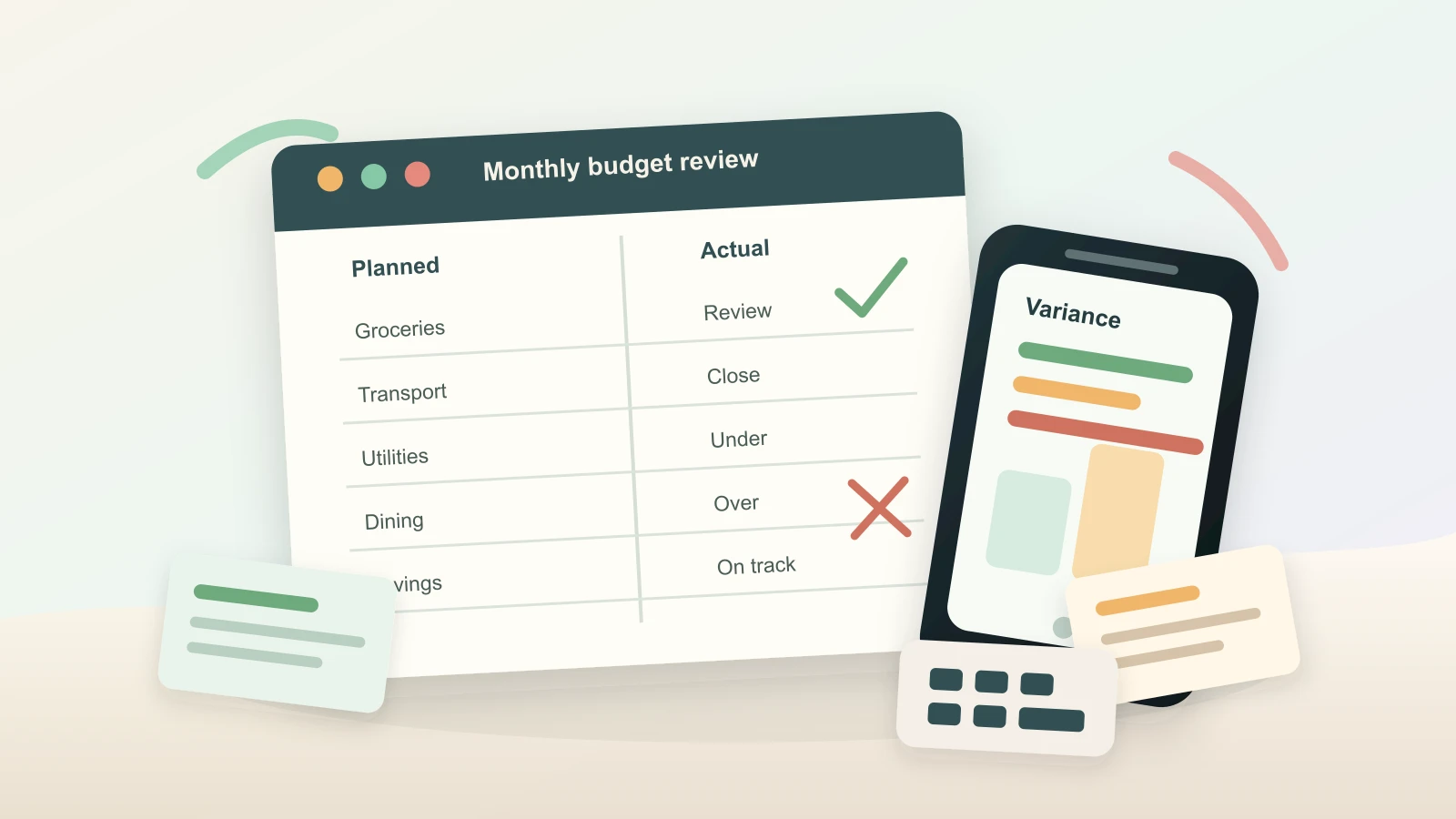
A budget is a guess with structure. It says what you expect your money to do before the month starts. Real life then adds grocery price changes, forgotten renewals, social plans, delayed reimbursements, extra fuel, lower utility use, and small choices you barely remember making.
That difference between the plan and the result is not proof that the budget failed. It is information.
A budget variance review is a calm way to compare what you planned with what actually happened. Instead of deleting the budget, blaming yourself, or carrying the same unrealistic numbers forward, you learn from the gap and make the next plan easier to follow.
Know what a budget variance actually means
A variance is the difference between your budgeted amount and your actual amount. If you planned 400 for groceries and spent 465, the variance is 65 over budget. If you planned 120 for fuel and spent 95, the variance is 25 under budget.
The number matters, but the reason matters more. A category can be over budget for several different reasons:
- The original budget was too low
- Prices changed
- A bill arrived earlier than expected
- A one-time event landed in the category
- You made an intentional tradeoff
- Small unplanned purchases added up
- A subscription, fee, or renewal was forgotten
Those causes need different responses. A forgotten annual fee belongs in a future sinking fund. A grocery category that is over every month may need a more honest baseline. A planned birthday dinner might simply be a conscious choice that needs room somewhere else.
The goal is not to make every category perfect. The goal is to understand which gaps deserve an adjustment.
Compare planned and actual spending by category
Start with a simple category-by-category review. You do not need a complicated spreadsheet. You need three pieces of information:
- The amount you planned
- The amount you actually spent
- The difference between the two
If you use Furt Money, review your spending categories for the month and compare them with the budget you expected to follow. Make sure transactions are categorized before judging the results. A few purchases sitting in the wrong category can make the review look worse than it really is.
Work from the biggest gaps first. A 3 difference in snacks is usually not worth a long conversation with yourself. A 180 difference in transport, groceries, medical costs, or dining out may reveal something useful.
Try using three quick labels:
- Over plan
- Under plan
- Close enough
“Close enough” is important. A budget that misses every small category by a few dollars may still be working well. Save your attention for the gaps that affected cash flow, debt payments, savings, or your stress level.
Separate timing problems from spending problems
Not every variance means you spent too much. Sometimes the budget and the calendar simply disagreed.
A timing problem happens when an expense is real, expected, and affordable, but it lands in a different month or pay period than planned. Examples include a utility bill posting early, a paycheck arriving after a weekend, a subscription renewing before you remembered it, or a reimbursement arriving later than expected.
A spending problem happens when the total cost is higher than your plan can comfortably support. That might be repeated takeout, higher grocery costs, unplanned shopping, rideshare habits, extra fees, or a category that never had enough room in the first place.
Ask this before making changes: “Would this still be a problem if it happened next month instead?”
If the answer is no, you may need a better cash-flow calendar or bill buffer. If the answer is yes, the category probably needs a new limit, a new habit, or a tradeoff from another part of the budget.
This distinction keeps you from solving the wrong problem. A timing issue needs smoother planning. A spending issue needs a clearer decision.
Look for repeated gaps, not one-off noise
One month can be misleading. A budget variance review becomes more useful when you look for patterns across two or three months.
Review your categories and ask:
- Which categories are over budget almost every month?
- Which categories are under budget almost every month?
- Which categories swing wildly from month to month?
- Which expenses keep surprising you even though they are predictable?
- Which category creates the most stress when it goes wrong?
Repeated overages usually mean the number is unrealistic, the category is too broad, or the spending habit needs a clearer boundary. Repeated under-spending can mean you are overfunding one area while another category is too tight.
Irregular categories deserve special attention. Gifts, repairs, school costs, medical visits, car maintenance, travel, and home supplies rarely behave like neat monthly bills. If those categories keep creating variance, a monthly set-aside may work better than hoping the next month stays quiet.
Do not overcorrect after one unusual month. A wedding trip, appliance repair, or medical appointment may explain a spike without changing your normal budget. The pattern is the clue.
Turn overages into a practical next step
When a category is over budget, avoid vague promises like “spend less next month.” Choose a response you can actually use.
Here are a few options:
- Raise the category if the old number was unrealistic
- Split a messy category into clearer parts
- Create a sinking fund for irregular costs
- Add a short waiting period before nonessential purchases
- Move money from a lower-priority flexible category
- Set a weekly limit instead of one monthly number
- Review transactions mid-month instead of waiting until the end
For example, if dining out is over budget because workdays are hectic, the solution may not be a stricter dining-out number. It may be a small grocery plan, an easy backup meal, or a separate “busy week food” category.
If shopping is over because several small orders felt harmless, the next step might be a weekly review and a 24-hour pause before checkout. If fuel is over because your commute changed, the budget number may simply need to rise.
The best fix matches the reason for the gap. A good budget variance review turns judgment into a decision.
Use under-budget categories on purpose
Being under budget can feel like an automatic win, but it is still worth reviewing. Money left in a category can help, disappear, or hide an unrealistic plan.
When a category comes in under budget, choose what happens next:
- Roll it into the same category if a larger expense is coming
- Move it to emergency savings or another priority
- Use it to cover a category that went over
- Lower the category next month if it is consistently too high
- Leave it as a cushion if the category is unpredictable
For example, if your utility bill was lower during a mild month, keeping the extra money in a utilities buffer may help when the season changes. If you consistently budget more for subscriptions than you actually spend, that extra room may be better used for savings, debt, or groceries.
This is also where a budget can become kinder. If you are under budget because you skipped every fun plan and felt resentful, the number may not be sustainable. A budget should protect your future without making ordinary life feel permanently squeezed.
Build a repeatable review routine
A budget variance review works best when it is short enough to repeat. You do not need to inspect every receipt or rebuild your entire money system.
Try this 20-minute routine near the end of each month:
- Categorize recent transactions.
- Compare planned and actual spending.
- Circle the three largest gaps.
- Write one plain-language reason for each gap.
- Decide whether each gap is a timing issue, a one-time event, or a pattern.
- Change next month’s budget in only the categories that need it.
- Pick one habit or reminder to test before the next review.
Keep the notes simple. “Groceries up because we hosted twice” is useful. “Need to stop being bad with money” is not.
If you share money with someone else, keep the tone factual. Review the numbers before blame enters the room. The question is, “What should the next plan know?” not, “Who ruined the last one?”
Make next month’s budget more honest
The most useful budget is not the strictest one. It is the one that can survive your actual life.
After the review, update next month’s plan with what you learned. Give recurring pressure points enough room. Create small buffers for categories that swing. Move money away from categories that are always padded. Add reminders for annual renewals, school costs, insurance payments, travel, or other expenses that tend to arrive without warning.
You may also decide to track one category more closely for a month. If groceries are unclear, review them weekly. If subscriptions are scattered, audit them once. If cash withdrawals blur the details, create a simple note for where the cash goes.
The point is progress, not perfection. Each review should make the next budget a little more believable.
Conclusion
A budget variance review helps you treat gaps as feedback instead of failure. Compare the plan with reality, understand the reason, and make one or two useful changes before the next month begins.
Start with the largest difference in your budget. Name why it happened, decide whether it is a timing issue or a pattern, and adjust the next plan while the lesson is still fresh.