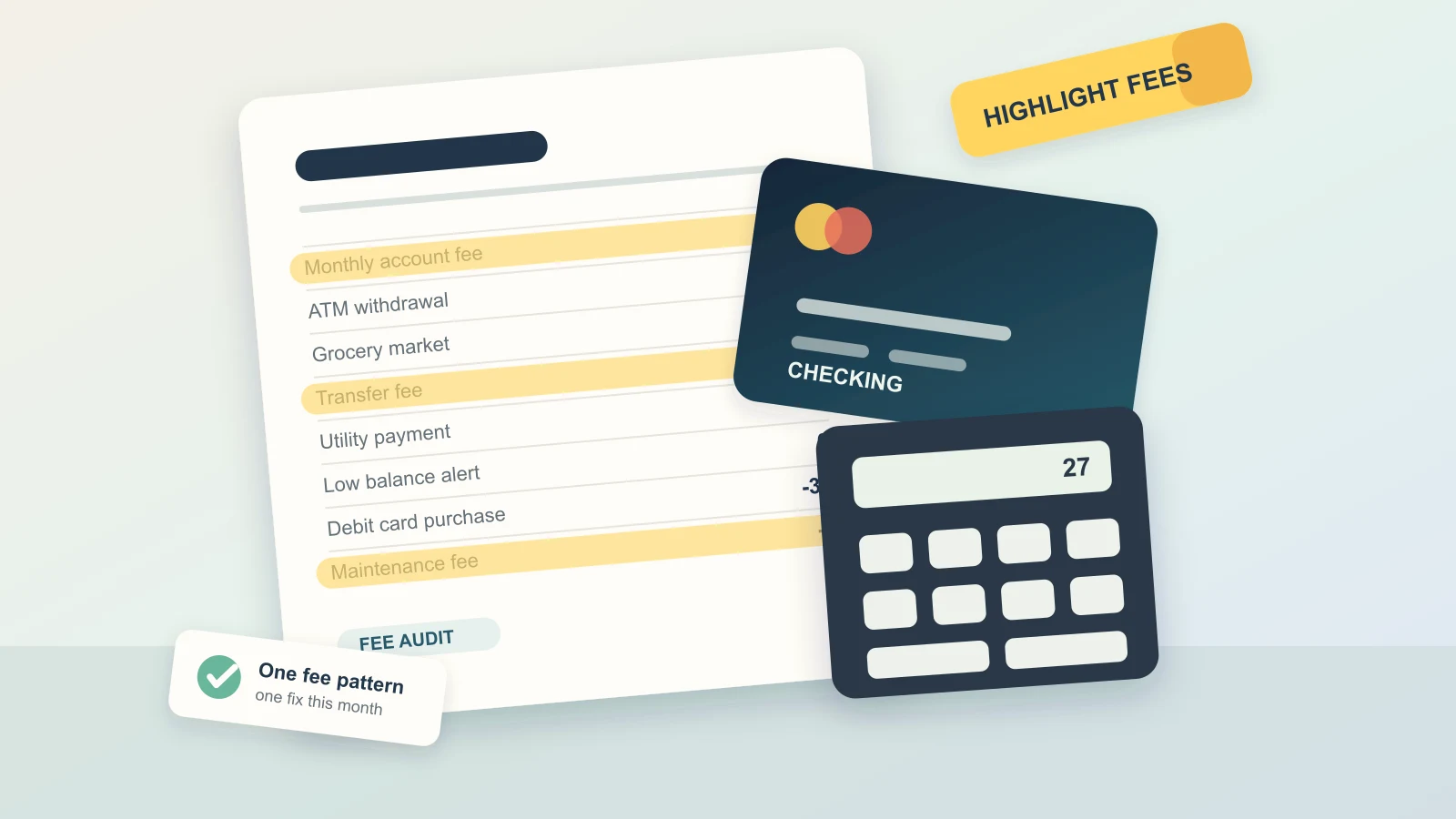
Bank fees rarely feel like a major budget category. One charge looks annoying, another looks normal, and a third gets missed because it lands between groceries, subscriptions, and card payments. Over time, those small charges can make your checking account feel tighter than it needs to be.
A bank fee audit is a simple review of the costs connected to your everyday accounts. The goal is not to judge every past mistake. The goal is to find patterns, remove fees you can avoid, and build a routine that keeps your account easier to trust.
Start with the accounts you actually use
Begin with the accounts where money moves in and out most often. For most people, that means a primary checking account, one or two savings accounts, a debit card, and any payment app balance that acts like a mini bank account.
Do not try to audit every old account in the first sitting. Start with the places that affect this month:
- where your paycheck or income arrives
- where rent, utilities, or loan payments leave
- where debit-card purchases clear
- where automatic transfers or savings rules run
- where cash withdrawals happen
If you use Furt Money to track expenses, this is a good time to review recent banking-related categories or notes. You may already see patterns, such as cash withdrawal fees, returned-payment charges, or recurring account costs that never got their own category.
Pull the last three statements
A single month can be misleading. You might have traveled, changed jobs, paid an annual fee, or had an unusual bill timing problem. Three months gives you enough history to see repeats without turning the audit into a research project.
Download or open statements for each active account. Then search or scan for words like:
- fee
- charge
- overdraft
- insufficient funds
- ATM
- maintenance
- wire
- transfer
- replacement card
- foreign transaction
Some fees may appear with bank-specific labels, so do a second pass through the transaction list if the search does not catch much. You are looking for costs that came from account rules, payment timing, account usage, or access choices - not normal purchases.
Sort fees by cause, not just amount
It is tempting to start with the largest charge, but the most useful question is why the fee happened. A small repeated fee can matter more than one unusual charge you already fixed.
Use simple groups:
- Timing fees: overdrafts, returned payments, late transfers, or bills that hit before income cleared
- Access fees: out-of-network ATM charges, cash advance-style costs, card replacement fees, or teller service fees
- Account fees: monthly maintenance fees, minimum-balance fees, paper statement fees, or inactive account fees
- Transfer fees: wire charges, instant transfer fees, international transfer costs, or payment app cash-out fees
- Travel and currency fees: foreign transaction fees, international ATM fees, or conversion-related costs
Once each fee has a cause, the fix becomes clearer. A timing fee may need a checking buffer or a due-date adjustment. An access fee may need a cash plan. An account fee may mean the account no longer fits the way you use money.
Turn repeat fees into budget signals
A bank fee is useful information if you treat it as a signal. Ask what the fee is trying to tell you.
If overdrafts happen near the same week each month, your budget may have a cash-flow problem rather than a discipline problem. A cash-flow calendar can help you see whether bills are stacked too close together. A small checking account buffer can also reduce the risk of one early charge creating a chain reaction.
If ATM fees show up often, your budget may need a planned cash category. Instead of withdrawing small amounts in a hurry, choose one or two cash days and use machines that fit your account. If that is not realistic, at least make the cost visible so it does not hide inside general spending.
If monthly account fees keep appearing, compare the account rules with your actual behavior. Some accounts waive fees only when certain conditions are met. If you do not naturally meet those conditions, the account may be asking for a routine you do not want to maintain.
Build a quick fee prevention checklist
After you know the pattern, create a short checklist you can repeat monthly. Keep it practical enough that you will actually use it.
Try this version:
- Check the available balance before large automatic payments.
- Confirm the next five bills due before the next payday.
- Keep one small buffer amount untouched in checking if possible.
- Review account alerts and turn on low-balance notifications.
- Use a planned cash withdrawal instead of urgent small withdrawals.
- Review monthly account requirements before the statement closes.
- Categorize any fee immediately so it becomes visible in your spending review.
The checklist should reduce surprises, not create another stressful money ritual. If seven steps feels like too much, start with the first three.
Decide when to call, switch, or simplify
Some fees are worth questioning directly. If a fee was caused by a genuine mistake, confusing timing, or a first-time issue, you can contact the bank and ask whether it can be reversed. There is no guarantee, but a polite request is often worth a few minutes.
Other fees are a sign that the account may not match your life. If you keep paying for features you do not use, or you keep missing requirements that do not fit your income pattern, compare simpler options. Focus on account fit, not marketing promises.
You can also simplify without switching banks. Closing an unused account, changing a statement setting, moving one automatic bill, or choosing a default ATM plan may remove more friction than opening something new.
Add fees to your normal money review
A bank fee audit works best when it becomes part of a small review rhythm. You do not need to repeat the full audit every week. Just give fees a place to show up.
During a weekly or monthly money review, ask:
- Did any account fee appear this period?
- Did a bill arrive before the money was ready?
- Did an ATM or transfer fee happen because I was rushed?
- Is this fee a one-time mistake or a repeat pattern?
- What one change would make this less likely next time?
If you track spending in Furt Money, keep fees in a clear category instead of burying them inside the purchase that caused them. Visibility is the point. A fee you can see is easier to prevent than a fee that disappears into the background.
Make one change before the next statement
Do not finish the audit with a long list of perfect intentions. Pick one change that can happen before the next statement closes.
That might be setting a low-balance alert, moving a bill by a few days, building a small checking buffer, choosing a cash withdrawal day, turning off paper statements, or closing an account you no longer use. The best first change is the one that removes a repeat fee with the least effort.
Bank fees may never become your biggest expense, but they are often one of the easiest leaks to spot. Find the pattern, make the cost visible, and fix one cause at a time. A calmer account starts with knowing which charges deserve your attention.