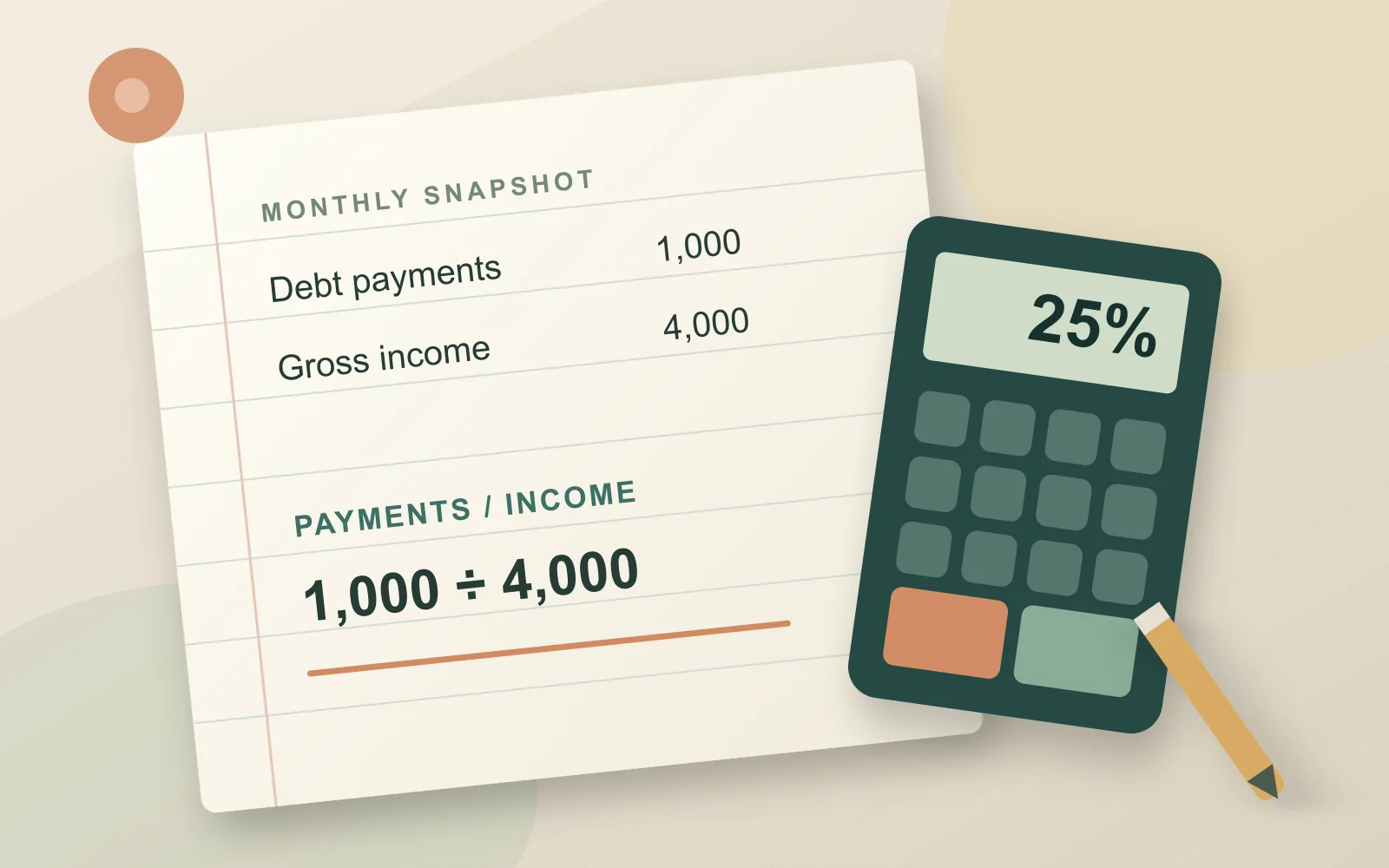
A loan balance tells you how much you owe. It does not tell you how much of each month’s income is already committed to payments. Your debt-to-income ratio, or DTI, is a way to see that monthly burden in proportion to your income. It is useful when you are considering another payment—but it is not a complete test of whether that payment will feel comfortable.
What debt-to-income ratio measures
The basic calculation is monthly debt payments ÷ gross monthly income × 100. Gross income means income before taxes and other deductions. The Consumer Financial Protection Bureau’s explanation uses this definition and notes that lenders use DTI as one measure of ability to manage payments. Lenders and loan products can use different limits and rules, so no single percentage guarantees an approval or a good decision.
This is a payment ratio, not total debt divided by annual salary. A smaller loan with a short repayment schedule could demand more each month than a larger loan with a longer schedule. DTI does not tell you the interest cost, either.
Add up payments without double counting
Collect your current loan and card statements. Write down each required monthly debt payment, including any housing loan payment and other installment debt you actually owe. For credit cards, use the required payment shown on your statement for a snapshot, rather than adding the entire card balance as if it were due each month. The required payment can change, so recalculate when statements change. If an account has an unusual schedule, convert its required payments into a comparable monthly amount and note the assumption.
Do not add the purchase and its later card payment as two separate debts. Likewise, avoid counting a transfer between your own accounts as a debt payment. If you are checking a lender’s definition, ask what it includes; your own budget should still record real spending such as rent, food, utilities, and transport even when those items are not included in a particular DTI calculation.
Keep a simple list: account nickname, required payment, next due date, and statement date. Avoid putting full account numbers in a shared file.
Choose the right income number
For the conventional DTI calculation, start with gross monthly income. If you are paid a fixed amount each month, use the gross figure from your payslip rather than your take-home deposit. With variable income, use a documented period that reflects your normal pattern and keep the period visible. A high-earning month on its own can make a recurring obligation look easier than it will be in a quiet month.
A lender may calculate qualifying income differently from your own estimate. Do not treat an informal calculation as a lending decision. For your personal cash-flow check, make a separate comparison against take-home pay; taxes and deductions are not money available to pay bills.
Work through a small example
Imagine a person with gross monthly income of 4,000 units of currency and these illustrative required payments:
- Housing loan: 700
- Vehicle loan: 250
- Credit card minimum: 50
The monthly debt-payment total is 1,000. Dividing 1,000 by 4,000 gives 0.25, or 25%. If a new loan would add a required payment of 200, the illustrative ratio becomes 1,200 ÷ 4,000 = 30%. This comparison shows the mechanical change, not whether the new borrowing is affordable or likely to be approved.
Now do a separate cash check. Suppose this person’s take-home pay is 3,100, and essential non-debt costs plus the existing debt payments total 2,850. That leaves 250 before irregular costs, savings, and discretionary spending. A new 200 payment would leave only 50 for all of those. The DTI figure alone does not reveal that squeeze. All figures here are made-up examples, not targets.
Read the number without chasing a magic cutoff
A lower DTI generally means less gross income is committed to required debt payments, but the ratio leaves out important detail. It cannot show whether payments fall before payday, whether a loan’s rate changes, whether an essential bill is unusually high, or how much cash you have for repairs. It also does not show whether a payment is temporary or the trade-off you would make to take it on.
Rather than comparing yourself with a universal “good” number, ask: Which payments are fixed? Which may change? What remains after taxes and essentials? If you are considering a loan, review the actual terms and monthly schedule, and compare them with a cautious month in your budget. Qualification and comfort are different questions.
Use DTI alongside an actual spending review
Recalculate when income or a required payment changes, and keep the calculation beside a simple cash-flow plan. First reserve money for essentials and current obligations; then look at irregular bills, a buffer, and goals. If you track expenses in Furt Money, review your categories and spending patterns to make the non-debt side of that plan less guessy. The app’s spending review is not a lender’s DTI assessment.
If required payments already crowd out essentials, do not use a new ratio calculation as a reason to borrow more. Confirm each account’s terms and discuss difficulties early with the provider or a reputable local debt adviser. Rules and options vary by place and provider.
Your next ten-minute check
Take the latest statements for your debts, total the required monthly payments, and divide by your gross monthly income. Write the date and assumptions next to the result. Then use your take-home income to check how much remains after debt payments and essential spending. That second number is often the more useful answer to the everyday question: “Will this fit next month?”